1. What is statistics?
Statistics is the study of collecting, organizing, analyzing and interpreting data.
2. Who is the father of modern statistics?
Sir Ronald A. Fisher is considered the father of modern statistics.
3. Define statistical table.
A statistical table is a way of organizing data in rows and columns for easy comparison and analysis.
4. What is business statistics?
Business statistics is the application of statistical methods to solve business-related problems and make decisions.
5. Define inclusive method with example.
The inclusive method is when the upper limit of a class interval is included in that interval.
Example: 10-19 includes 19
6. What is constant?
A constant is a value that does not change at different level.
7. What is open-end class interval?
An open-end class interval has no specific upper or lower limit.
8. What is data?
Data is information collected for analysis.
9. What is secondary data?
Secondary data is information that was collected by someone else for a different purpose, like research papers or reports.
10. What is stem and leaf display?
Stem and leaf display is a way to organize data where each number is split into a “stem” (leading digit) and a “leaf” (last digit)
11. What is pictogram?
A pictogram is a visual representation of data using pictures or symbols.
12. What is primary data?
Primary data is data that is collected directly from the source for a specific purpose.
13. Write the definition of continuous variable with example.
A continuous variable can take any value within a range. Example: height or weight.
14. What is variable?
A variable is something that can change or vary, like age or temperature.
15. Define discrete variable?
A discrete variable is one that can only take specific values. Example: number of children.
16. What is cumulative frequency curve?
A cumulative frequency curve is a graph showing the cumulative total of frequencies up to each class interval.
17. What is frequency density?
Frequency density is the frequency of a class interval divided by its class width.
18. What is frequency?
Frequency is how often a particular value or range of values appears in a data set.
19. What is frequency distribution?
Frequency distribution is a way of organizing data to show how frequently each value or range of values occurs.
20. What is questionnaire?
A questionnaire is a set of questions used to collect information from individuals.
21. What is meant by histogram?
A histogram is a bar graph that shows the frequency distribution of continuous data.
22. What is class interval?
A class interval is a range of values into which data is grouped.
23. What is meant by classification?
Classification is the process of sorting data into different categories or groups.
24. Write down the surges rule?
The Surges rule helps to calculate the class interval for grouped data: Class Interval = (Maximum Value – Minimum Value) / Number of classes.
25. What is population?
Population is the entire group that you want to study or make conclusions about.
26. What is BBS?
BBS stands for Bangladesh Bureau of Statistics, which is responsible for collecting and analyzing statistical data in Bangladesh.
1. What is central tendency?
Central tendency refers to the middle or typical value of a data set.
2. What are measures of central tendency?
The measures of central tendency are mean, median, and mode.
3. What is quartile?
A quartile is a value that divides the data set into four equal parts.
4. What is the relationship among AM, GM & HM?
The relationship is: AM ≥ GM ≥ HM, where AM is the arithmetic mean, GM is the geometric mean, and HM is the harmonic mean.
5. When AM, GM & HM are equal?
AM, GM, and HM are equal when all values in the data set are the same.
6. Define Geometric Mean?
Geometric mean is the average of a set of numbers found by multiplying them and then taking the nth root.
8. What is harmonic mean?
Harmonic mean is the reciprocal of the average of the reciprocals of the numbers.
9. Write down two merits of harmonic mean?
(a) It is useful when calculating average rates, like speed.
(b) It reduces the e ect of very large numbers.
10. What is average?
Average is the sum of all values divided by the number of values.
11. What is weighted arithmetic mean?
Weighted arithmetic mean is the average where each value has a di erent weight or importance.
12. What do you understand by weighted mean?
Weighted mean is the average calculated by giving di erent importance to di erent values.
13. Which measure is the best average?
There is no single best average; it depends on the data, but the mean is commonly used
14. Find the mean of first 10 numbers?
The mean of the first 10 numbers (1 to 10) is 5.5.
15. What is raw data?
Raw data is unprocessed data collected directly from a source.
16. Mutually exclusive events?
Mutually exclusive events cannot happen at the same time.
17. What is Bar Diagram?
A bar diagram is a graph that uses bars to represent data and compare di erent categories.
18. What is the mode of 15, 18, 15, 20, 25 & 15?
The mode is 15, as it appears most often.
19. What is weighted average?
Weighted average is an average where each value is multiplied by a weight and then summed up before dividing by the total weight.
1. What is dispersion/variability?
Dispersion or variability shows how spread out the data is from the average.
2. What are di erent measures of dispersion?
The main measures of dispersion are range, variance, standard deviation, and interquartile range.
3. What is range?
Range is the difference between the highest and lowest values in a data set.
4. What is standard deviation?
Standard deviation is a measure of how spread out the numbers in a data set are.
5. What is combined standard deviation?
Combined standard deviation is the overall standard deviation when combining two or more data sets.
6. What is the five-number summary?
The five-number summary includes the minimum, first quartile, median, third quartile, and maximum of a data set.
7. What is variance?
Variance measures how far each number in a data set is from the mean, showing the spread of data.
8. Write the formula of variance.
The formula of Sample Variance: Variance = (×–μ)² / N
9. What is the coe cient of variation?
The coefficient of variation is the ratio of the standard deviation to the mean, showing relative variability.
10. Define mean deviation.
Mean deviation is the average of the absolute differences between each data point and the mean.
11. What is the range of 0, -2?
The range is the difference between 0 and -2, which is 2.
12. Define interquartile range.
The interquartile range is the difference between the third quartile (Q3) and the first quartile (Q1), showing the spread of the middle 50% of data.
13. What is covariance?
Covariance measures how two variables change together, showing whether they increase or decrease together.
14. What is a box plot?
A box plot is a graph that shows the minimum, first quartile, median, third quartile, and maximum of a data set.
15. What are relative measures?
Relative measures compare values to other values, like ratios or percentages, to show how one value relates to another
1: what is Correlation?
Correlation indicates how closely and in what direction two variables change together.
2. Define coe cient of correlation?
The coefficient of correlation shows how strongly two variables are related, ranging from -1 (perfect negative) to 1 (perfect positive).
3. What is rank correlation?
Rank correlation is a way to measure the relationship between two variables by comparing their ranks.
4. Why is correlation used?
Correlation is used to understand the relationship between two variables and how they change together.
5. How do you know if correlation is strong or weak?
If the correlation coefficient is close to 1 or -1, the correlation is strong. If it’s close to 0, it’s weak.
6. What is regression?
Regression is a method used to understand the relationship between a dependent variable and one or more independent variables.
7. What is the regression line?
The regression line is a straight line that best represents the relationship between variables in a regression analysis.
8. What is the regression model?
The regression model is an equation that describes the relationship between variables, typically involving the dependent and independent variables.
9. What is regression analysis?
Regression analysis is a statistical method to find the relationship between a dependent variable and one or more independent variables.
10. Define regression coe cient?
The regression coefficient tells us how much the dependent variable changes when an independent variable changes by one unit.
11. What is the dependent variable?
The dependent variable is the outcome you are trying to predict or explain in an analysis.
12. What is the least square method?
The least square method is used to find the line that best fits the data by minimizing the squared differences between the points and the line.
13. What is a scatter diagram?
A scatter diagram is a graph that shows the relationship between two variables using points.
14. What is an empty set?
An empty set is a set that contains no elements.
15. What is meant by multiple regressions?
Multiple regressions is a method to predict the value of a dependent variable based on two or more independent variables.
16. What do you mean by r =0?
It means there is no connection between two things.
1. What is probability?
It is the chance of something happening. It can be between 1(possible) and 0(impossible).
2. What are mutual exclusive events?
We can’t get both heads and tails in one times its called mutual exclusive events.
3. Define joint probability?
The chance of two things happening together called joint probability.
4. What is conditional probability?
The chance of something happening, given another thing has already happened.
5. What is significance level?
It’s the level that tells us whether a result is important or not in a test.
6. Explain the meaning of P(A)=0 and P(A)=1?
Explain: P(A)= 0: It cannot happen and P(A)= 1: It will happen for sure.
7. What is probability tree?
A probability tree is a diagram that shows all possible outcomes of an event and their chances.
8. When events are called equally likely events?
When all events have the same chance it’s called equally likely events
9. What is random variable?
A random variable is a number that can be different each time you do something randomly, like the result of a dice roll.
10. What is binomial distribution?
It is a way to find the probability of getting a certain number of successes in a fixed number of tries.
11. What is marginal probability?
Marginal probability is the chance of one event happening ignoring other.
12. What is combination?
Combination is choosing items from a group where the order doesn’t matter.
13. What is the variance of binomial distribution?
It is np(1-p) where n is tries, p is success chance.
14.What is meant by event?
An event is something that can happen, like getting heads in a coin flip.
15. What is the highest value of a probability of an event?
The highest value is 1, meaning the event is sure to happen.
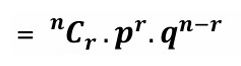
16. What is the probability function of binomial distribution?
Function of binomial distribution
1. What is sampling?
Sampling is the process of selecting a subset of individuals or items from a larger population for study or analysis.
2. What is sample survey?
A sample survey is a method of collecting data from a small group to understand a larger population.
3. What is large sample?
A large sample is a group with many individuals or items used for study.
4. What is sampling error?
Sampling error is the difference between the result from the sample and the actual population result.
5. What is population?
Population is the entire group of people or items that we want to study.
6. What are parameters?
Parameters are values that describe the characteristics of the whole population, like the average.
7. What is significance level?
Significance level is the limit used to decide if a result is important, often shown as 0.05 or 5%.
8. What is critical value?
Critical value is a number that helps determine whether a test result is significant or not.
9. What is Null Hypothesis?
Null Hypothesis is the assumption that there is no effect, no difference, or no change in the situation being studied.
10. What is meant by sample space?
Sample space is all the possible results of an event
11. What is meant by sample point?
A sample point is one possible result from all the possible outcomes.
1.What is Index?
An index is a list or Process that can provide information quickly.
2. What is index number?
An index number shows changes in a value, like price or quantity, over time.
3. What is price index?
A price index measures the change in prices of goods and services over time.
4. What is consumer price index number?
The consumer price index (CPI) measures the change in prices of items that people buy for daily use.
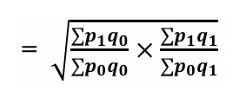
5. Write down Fisher’s price index formula.
Fisher’s price index formula is:
6. What is chain index?
A chain index measures changes over time by linking index numbers from one period to the next.
7. What is quantity index?
A quantity index shows changes in the quantity of goods over time.
8. Under what condition is the time reversal test satisfied?
The time reversal test is satisfied when reversing time gives the same index value.
9. Under what condition is the factor reversal test satisfied?
The factor reversal test is satisfied when multiplying the price and quantity index gives the value of total change.
10. Which index number is ideal?
Fisher’s index is considered the ideal index.
11. What is the ideal index?
The ideal index satisfies both the time reversal and factor reversal tests, like Fisher’s index.
1. What is time series?
A time series is a set of data points collected over time, usually at regular intervals.
2. What is business forecasting?
Business forecasting is predicting future trends or outcomes based on past data.
3. What is least square method?
The least square method is a way to find the line that best fits data points by minimizing the differences between the points and the line.
4. What is scatter diagram?
A scatter diagram is a graph that shows the relationship between two variables using points on a grid.
5. What are the components of time series?
The components of time series are:
(a) Trend
(b) Seasonal variation
(C) Cyclical variation
(d) Irregular variation.
1. What is statistics?
Statistics is the study of collecting, organizing, analyzing and interpreting data.
2. Who is the father of modern statistics?
Sir Ronald A. Fisher is considered the father of modern statistics.
3. Define statistical table.
A statistical table is a way of organizing data in rows and columns for easy comparison and analysis.
4. What is business statistics?
Business statistics is the application of statistical methods to solve business-related problems and make decisions.
5. Define inclusive method with example.
The inclusive method is when the upper limit of a class interval is included in that interval.
Example: 10-19 includes 19
1. What is central tendency?
Central tendency refers to the middle or typical value of a data set.
2. What are measures of central tendency?
The measures of central tendency are mean, median, and mode.
3. What is quartile?
A quartile is a value that divides the data set into four equal parts.
4. What is the relationship among AM, GM & HM?
The relationship is: AM ≥ GM ≥ HM, where AM is the arithmetic mean, GM is the geometric mean, and HM is the harmonic mean.
5. When AM, GM & HM are equal?
AM, GM, and HM are equal when all values in the data set are the same.
6. Define Geometric Mean?
Geometric mean is the average of a set of numbers found by multiplying them and then taking the nth root.
8. What is harmonic mean?
Harmonic mean is the reciprocal of the average of the reciprocals of the numbers.
9. Write down two merits of harmonic mean?
(a) It is useful when calculating average rates, like speed.
(b) It reduces the e ect of very large numbers.
10. What is average?
Average is the sum of all values divided by the number of values.
11. What is weighted arithmetic mean?
Weighted arithmetic mean is the average where each value has a di erent weight or importance.
12. What do you understand by weighted mean?
Weighted mean is the average calculated by giving di erent importance to di erent values.
13. Which measure is the best average?
There is no single best average; it depends on the data, but the mean is commonly used
14. Find the mean of first 10 numbers?
The mean of the first 10 numbers (1 to 10) is 5.5.
15. What is raw data?
Raw data is unprocessed data collected directly from a source.
16. Mutually exclusive events?
Mutually exclusive events cannot happen at the same time.
17. What is Bar Diagram?
A bar diagram is a graph that uses bars to represent data and compare di erent categories.
18. What is the mode of 15, 18, 15, 20, 25 & 15?
The mode is 15, as it appears most often.
19. What is weighted average?
Weighted average is an average where each value is multiplied by a weight and then summed up before dividing by the total weight.
1. What is dispersion/variability?
Dispersion or variability shows how spread out the data is from the average.
2. What are di erent measures of dispersion?
The main measures of dispersion are range, variance, standard deviation, and interquartile range.
3. What is range?
Range is the difference between the highest and lowest values in a data set.
4. What is standard deviation?
Standard deviation is a measure of how spread out the numbers in a data set are.
5. What is combined standard deviation?
Combined standard deviation is the overall standard deviation when combining two or more data sets.
6. What is the five-number summary?
The five-number summary includes the minimum, first quartile, median, third quartile, and maximum of a data set.
7. What is variance?
Variance measures how far each number in a data set is from the mean, showing the spread of data.
8. Write the formula of variance.
The formula of Sample Variance: Variance = (×–μ)² / N
9. What is the coe cient of variation?
The coefficient of variation is the ratio of the standard deviation to the mean, showing relative variability.
10. Define mean deviation.
Mean deviation is the average of the absolute differences between each data point and the mean.
11. What is the range of 0, -2?
The range is the difference between 0 and -2, which is 2.
12. Define interquartile range.
The interquartile range is the difference between the third quartile (Q3) and the first quartile (Q1), showing the spread of the middle 50% of data.
13. What is covariance?
Covariance measures how two variables change together, showing whether they increase or decrease together.
14. What is a box plot?
A box plot is a graph that shows the minimum, first quartile, median, third quartile, and maximum of a data set.
15. What are relative measures?
Relative measures compare values to other values, like ratios or percentages, to show how one value relates to another
1: what is Correlation?
Correlation indicates how closely and in what direction two variables change together.
2. Define coe cient of correlation?
The coefficient of correlation shows how strongly two variables are related, ranging from -1 (perfect negative) to 1 (perfect positive).
3. What is rank correlation?
Rank correlation is a way to measure the relationship between two variables by comparing their ranks.
4. Why is correlation used?
Correlation is used to understand the relationship between two variables and how they change together.
5. How do you know if correlation is strong or weak?
If the correlation coefficient is close to 1 or -1, the correlation is strong. If it’s close to 0, it’s weak.
6. What is regression?
Regression is a method used to understand the relationship between a dependent variable and one or more independent variables.
7. What is the regression line?
The regression line is a straight line that best represents the relationship between variables in a regression analysis.
8. What is the regression model?
The regression model is an equation that describes the relationship between variables, typically involving the dependent and independent variables.
9. What is regression analysis?
Regression analysis is a statistical method to find the relationship between a dependent variable and one or more independent variables.
10. Define regression coe cient?
The regression coefficient tells us how much the dependent variable changes when an independent variable changes by one unit.
11. What is the dependent variable?
The dependent variable is the outcome you are trying to predict or explain in an analysis.
12. What is the least square method?
The least square method is used to find the line that best fits the data by minimizing the squared differences between the points and the line.
13. What is a scatter diagram?
A scatter diagram is a graph that shows the relationship between two variables using points.
14. What is an empty set?
An empty set is a set that contains no elements.
15. What is meant by multiple regressions?
Multiple regressions is a method to predict the value of a dependent variable based on two or more independent variables.
16. What do you mean by r =0?
It means there is no connection between two things.
1. What is probability?
It is the chance of something happening. It can be between 1(possible) and 0(impossible).
2. What are mutual exclusive events?
We can’t get both heads and tails in one times its called mutual exclusive events.
3. Define joint probability?
The chance of two things happening together called joint probability.
4. What is conditional probability?
The chance of something happening, given another thing has already happened.
5. What is significance level?
It’s the level that tells us whether a result is important or not in a test.
6. Explain the meaning of P(A)=0 and P(A)=1?
Explain: P(A)= 0: It cannot happen and P(A)= 1: It will happen for sure.
7. What is probability tree?
A probability tree is a diagram that shows all possible outcomes of an event and their chances.
8. When events are called equally likely events?
When all events have the same chance it’s called equally likely events
9. What is random variable?
A random variable is a number that can be different each time you do something randomly, like the result of a dice roll.
10. What is binomial distribution?
It is a way to find the probability of getting a certain number of successes in a fixed number of tries.
11. What is marginal probability?
Marginal probability is the chance of one event happening ignoring other.
12. What is combination?
Combination is choosing items from a group where the order doesn’t matter.
13. What is the variance of binomial distribution?
It is np(1-p) where n is tries, p is success chance.
14.What is meant by event?
An event is something that can happen, like getting heads in a coin flip.
15. What is the highest value of a probability of an event?
The highest value is 1, meaning the event is sure to happen.
16. What is the probability function of binomial distribution?
Function of binomial distribution
1. What is sampling?
Sampling is the process of selecting a subset of individuals or items from a larger population for study or analysis.
2. What is sample survey?
A sample survey is a method of collecting data from a small group to understand a larger population.
3. What is large sample?
A large sample is a group with many individuals or items used for study.
4. What is sampling error?
Sampling error is the difference between the result from the sample and the actual population result.
5. What is population?
Population is the entire group of people or items that we want to study.
6. What are parameters?
Parameters are values that describe the characteristics of the whole population, like the average.
7. What is significance level?
Significance level is the limit used to decide if a result is important, often shown as 0.05 or 5%.
8. What is critical value?
Critical value is a number that helps determine whether a test result is significant or not.
9. What is Null Hypothesis?
Null Hypothesis is the assumption that there is no effect, no difference, or no change in the situation being studied.
10. What is meant by sample space?
Sample space is all the possible results of an event
11. What is meant by sample point?
A sample point is one possible result from all the possible outcomes.
1.What is Index?
An index is a list or Process that can provide information quickly.
2. What is index number?
An index number shows changes in a value, like price or quantity, over time.
3. What is price index?
A price index measures the change in prices of goods and services over time.
4. What is consumer price index number?
The consumer price index (CPI) measures the change in prices of items that people buy for daily use.
5. Write down Fisher’s price index formula.
Fisher’s price index formula is:
6. What is chain index?
A chain index measures changes over time by linking index numbers from one period to the next.
7. What is quantity index?
A quantity index shows changes in the quantity of goods over time.
8. Under what condition is the time reversal test satisfied?
The time reversal test is satisfied when reversing time gives the same index value.
9. Under what condition is the factor reversal test satisfied?
The factor reversal test is satisfied when multiplying the price and quantity index gives the value of total change.
10. Which index number is ideal?
Fisher’s index is considered the ideal index.
11. What is the ideal index?
The ideal index satisfies both the time reversal and factor reversal tests, like Fisher’s index.
1. What is time series?
A time series is a set of data points collected over time, usually at regular intervals.
2. What is business forecasting?
Business forecasting is predicting future trends or outcomes based on past data.
3. What is least square method?
The least square method is a way to find the line that best fits data points by minimizing the differences between the points and the line.
4. What is scatter diagram?
A scatter diagram is a graph that shows the relationship between two variables using points on a grid.
5. What are the components of time series?
The components of time series are:
(a) Trend
(b) Seasonal variation
(C) Cyclical variation
(d) Irregular variation.
নিচের বাটনে ক্লিক করে, Continue বাটনে ক্লিক করে আপনার ব্রাউজার ওপেন করুন।
You cannot copy